Water reuse expert wins AAEES 40 Under 40 award
The American Academy of Environmental Engineers and Scientists names Kerri Hickenbottom, associate professor of chemical and environmental engineering, to its 40 Under 40 Recognition Program.

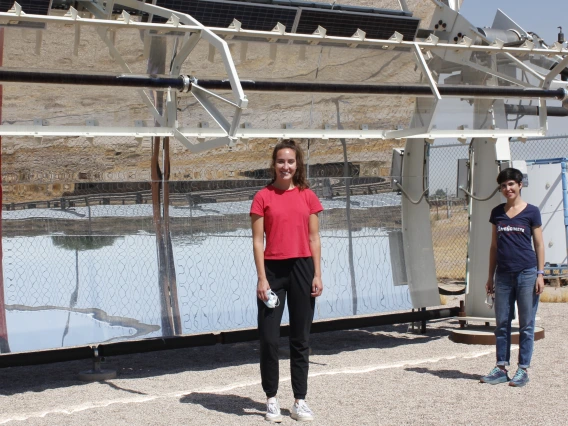
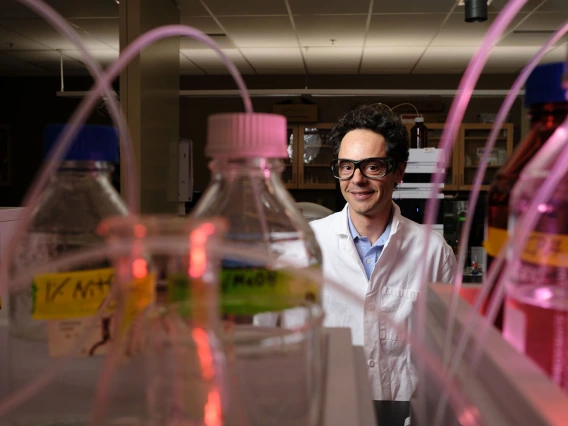
CHEE associate professor Kerri Hickenbottom designs water systems that reduce industrial use.
Kerri Hickenbottom, an associate professor in the Department of Chemical and Environmental Engineering, was named to the 40 Under 40 Recognition Program from the American Academy of Environmental Engineers and Scientists for 2026.
The AAEES, one of the nation’s premier professional scientific organizations, created the award to honor scientists who advance the environmental sciences.
“I am pleased that Kerri received the American Academy of Environmental Engineers and Scientists 40 Under 40 Award,” said Kimberly Ogden, CHEE chair and professor. “She joins an exceptional group of emerging leaders in her field who are making a meaningful impact on the world.”
Making desalination affordable and safe
Much of Hickenbottom’s research has examined the environmental and economic implications of water desalination – a technique that removes minerals and impurities from saltwater and brackish water. The process has grown more popular in Arizona as a viable solution to looming cuts in Colorado River water.
Separating minerals from water requires breaking chemical bonds, which demands significant energy and costs. Leftover brine can also harm the environment if not discharged properly.
To speed desalination research and lower costs, Hickenbottom scaled smaller lab models for real-world environments.
“It's really challenging because there are a lot of outside drivers that we don't really see in the lab,” she said. “I work at these different scales, and then we use the data and the results that we get at the larger scales, which leads to more fundamental research questions.”
Hickenbottom’s work includes a decentralized approach that reduces energy use for water processing and reclamation.
“The idea is rather than having a centralized system with water from semiconductor [fabrication] and other large facilities, let’s create dedicated systems where we recover water on-site,” she said. “We can minimize the risk from a lot of these larger infrastructure systems by having smaller systems that are fit for purpose and tuned more accurately to the kind of contaminants that are removed.”
Reducing data center energy, water use
Hickenbottom is also addressing one of today’s major infrastructure challenges: data centers with high energy and water demands. The strain on utilities is a problem for arid regions like Arizona.
“There's a lot of innovation in terms of computing and networking, and there is also opportunities for innovation throughout the levels of the physical infrastructure – from the chip, the board, the rack, the building and to the community,” she said. “We’re finding new ways to both support communities and enable critical infrastructure.”