53 Engineering clubs build skills, career connections
Three clubs join the college’s growing list of student organizations.

The Wildcat Robotics club recruits members at the College of Engineering club showcase, which is incorporated into the ENGR 102A class, on Sept. 22, 2026.

SEDS club table displays payloads the club has launched, along with equipment and materials for students interested in joining.
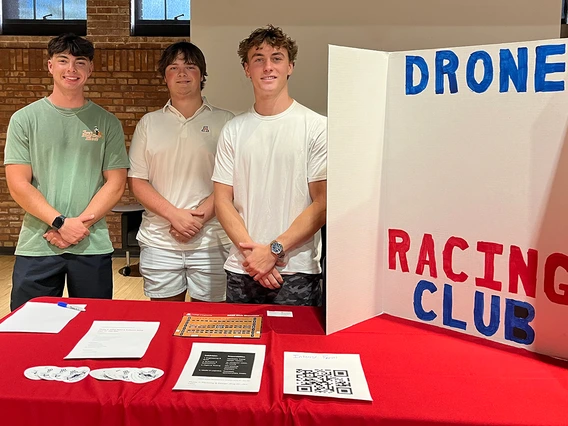
Club leaders crowded the Bear Down Gym for the annual College of Engineering club showcase on Sept. 22 and 24, 2026, to promote groups offering everything from high-altitude balloon research and forging to robotics and construction.
For many students, joining a club is a chance to build something tangible, develop skills outside class, make friends and even discover a career path.
Three clubs expanded the college’s offerings of student organizations to an all-time high of 53.
Earning research chops
Members of Students for the Exploration and Development of Space, or SEDS, design, build and launch payloads on high-altitude balloons that reach nearly 100,000 feet.
Club president Kane Mattison, an aerospace engineering senior, said the club’s ASCEND project helped him land an Arizona Space Grant internship at the University of Arizona Lunar and Planetary Laboratory.
“SEDS has been fundamental to my education,” Mattison said. “It’s helped me with internships and research, and I’ve been able to work on space projects through connections I’ve built in this club.”

(From left) Liora Wilkins, mechanical engineering senior; Tatiana Rastoskueva, computer science and engineering senior and Near Space Club president; and Helen Chen, molecular cellular biology senior, make friends at the Engineering club showcase.
The Near Space Club offers another way for students to look to the stars. Members launch payloads that test how materials and biological systems respond to near space – the region of Earth’s atmosphere between commercial flight routes and outer space.
“It’s very exciting to send things up to 100,000 feet,” said mechanical engineering senior Liora Wilkins. “I also felt like this club gives you a chance to really get involved in the planning of these experiments right away.”
The club's next experiment will simulate near-space conditions to see how they affect yeast.
“I was tired of sitting in the classroom just doing assignments, and I felt like I didn’t have enough experience building things – that’s why I joined this club,” said Tatiana Rastoskueva, senior computer science and engineering major and club president.
Shaping metal strengthens bonds
At a forging and casting facility, the Wildcat Forge Club turn heated metal into everything from wall hooks to blunted blades.
“It's all practical skills,” said Ranger Stevenson, club president and materials science and engineering PhD student. “We teach everyone how to work the metal, from holding a hammer to forging something of their own.”

From wall hooks to wizard wands, Wildcat Forge Club members turn heated metal into finished pieces they can take home.
Students from any major can join; no previous experience is required.
Stevenson also ties the work to materials science, explaining how a metal's microstructure changes during heating and quenching.
For cyber operations engineering sophomore Jacob Mann, the club offered a chance to pursue a childhood interest.
“When I was little, my father took me to Renaissance fairs and bought swords. I’ve always wanted to make my own,” he said.
Members then put their skills to the test at the Minerals, Metals and Materials Society Bladesmithing Competition, a biennial international contest in which teams design and forge a blade.
In 2024, the club placed third with “The Copper Head,” a tanto, or Japanese short sword, made with copper, rattlesnake leather and mesquite wood.
“This year, we’re going to do bigger projects like making a railroad spike knife and maybe even attempt an axe,” Stevenson said.
Infusing fun with skill-building
For students who prefer working closer to the ground, Wildcat Robotics offers a chance to design, build and battle robots.
Members spend the fall semester designing BattleBots-style robots, working with computer-aided design, or CAD, software and electronics. In the spring, they assemble their robots to compete in the Sonoran Showdown and the National Havoc Robot League.
“We have a lot of workshops, so students pick up a lot of skills that they can put on their resume,” said mechanical engineering junior Mindy Dinh, the club's marketing director.
Workshops cover CAD, soldering and other hands-on skills. Dinh said the club also builds members' confidence.
“A lot of clubs seem a little daunting, like, ‘Oh, I don't know if I really have the skills,’” she said. “But this club is truly welcoming.”
Linking campus to career
The Associated General Contractors club brings industry speakers to meetings to discuss careers and projects, and it offers professional development such as resume reviews.
“In this club, you get to meet people in the industry, learn about what they’re doing and ask questions that you don’t get to ask in class,” said civil engineering junior Logan Kunze, the club’s president.
Kunze also joined for the chance to compete in the Associated Schools of Construction competition in Reno, Nevada.
“What makes the competition so valuable is that you’re taking what you learn in class and applying it to a real construction project,” Kunze said. “You have to figure out the cost, the schedule and how you’re actually going to build it.”
For Kunze, the club helped turn an uncertain choice of major into a clear career path.
“As a freshman, I did not know why I chose civil engineering,” he said. “Joining this club reaffirmed that idea of, ‘OK, this is actually what I want to do.’”