Student balloon project goes on a world tour, twice over
University of Arizona radio club members transform early setbacks into a high-altitude journey that spans the planet.

Members of the university-community K7UAZ Amateur Radio Club meet weekly to design wireless communication systems and connect with fellow radio enthusiasts worldwide.
It was a beautiful spring day when the University of Arizona K7UAZ Amateur Radio Club gathered on top of the ENR2 building to release a balloon into the sky. But this was no child’s toy. Little more than a month later, their solar-powered, high-altitude balloon has now circled the globe twice.
The Amateur Radio Relay League provided $2,500 to help club vice president Daniel Huang and treasurer Briana Curley lead the StratoCat balloon project.
StratoCat’s concept is simple: A small balloon, just a few feet in diameter, carries a solar-powered radio transmitter weighing about 15 grams. Using the Weak Signal Propagation Reporter network, amateur radio operators around the globe can receive the signal and upload location data, allowing the team to track the balloon in real time.
“The system is very small and simple,” said Huang, an astrophysics sophomore. “But you’d be surprised how much we can do with that.”
The team’s first launch last fall brought mixed results. Of the three balloons deployed, one transmitted for about a day and reached New Mexico before going silent.
“It was disappointing,” said Curley, an electrical and computer engineering senior. “But we just kept trying.”
Rather than stall, the team leaned into the experience, holding a full failure analysis and redesigning key elements of the system. That approach paid off. After a March 22 launch, one balloon successfully entered the jet stream and has since completed two laps around the Earth.
“Real-world testing is irreplaceable,” Curley said. “You fail quickly, learn from it and improve.”
Students across academic disciplines have contributed to the effort, gaining hands-on experience in electronics, atmospheric science and systems design.

(From left) Amateur Radio Club mentor Curt Laumann, treasurer Briana Curley and vice president Daniel Huang launch StratoCat’s Mission 2 balloons.
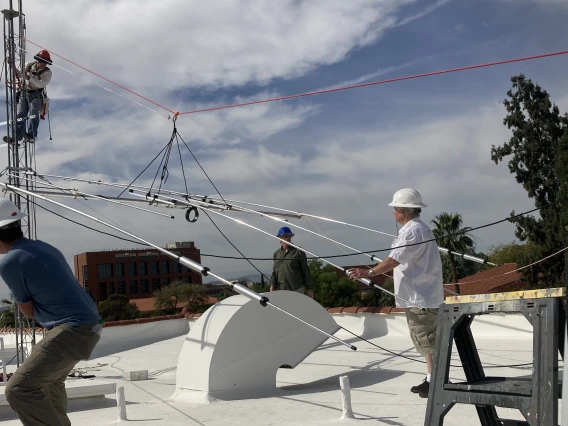
Curley helped secure funding and lead logistics, including antenna design and system assembly.
One of the most striking aspects of the project was its affordability – each balloon system costs roughly $20 to build. But the value of the experience to the students is immeasurable.
“You make lifelong friends through projects like this,” she said. “And it’s always better to work as a team.”
Beyond the technical achievements, the effort helped grow the amateur radio community on campus. Several students earned their amateur radio licenses, which grant access to worldwide amateur radio bands and operating modes.
Curt Laumann, a longtime amateur radio operator and volunteer mentor for the club, said the project’s greatest value lies beyond technical achievements.
“This project isn’t really about the balloon,” said Laumann, also a technology programs advocate in ECE. “It’s about giving students the experience to take ownership, adapt and grow.”
With another launch planned, the team is now focused on improving consistency and building on their success. Follow mission launches on their website.
“Projects like this teach you more than engineering,” Curley said. “They teach you how to solve problems, trust your team and keep going when things don’t work the first time.”