Quantum vanguard: NSF CAREER awardee advances networked codes
Assistant professor Narayanan Rengaswamy investigates codes that could stabilize connected quantum computers.

The University of Arizona’s Narayanan Rengaswamy (third from left) leads the SQALE research group to correct errors in quantum technology.
Quantum computing could one day reshape the digital landscape, but frequent errors slow its progress.
With a $826,210 CAREER Award from the National Science Foundation, Narayanan Rengaswamy, assistant professor of electrical and computer engineering, will build a network of quantum technology to test error-correcting codes necessary for large-scale quantum computing.

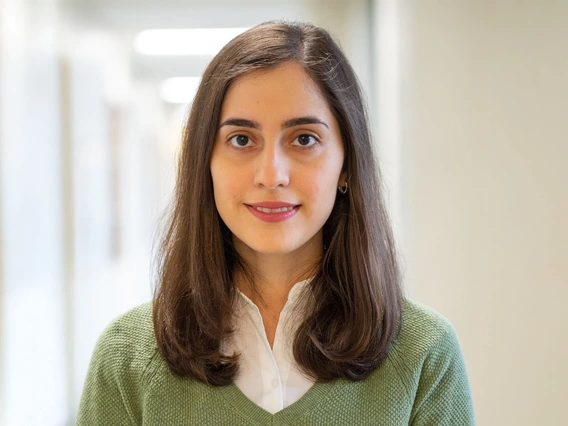
‘I feel deeply honored and validated that my vision for research and education is considered important enough by other experts to warrant this recognition,’ says CAREER awardee Narayanan Rengaswamy, assistant professor of ECE.
"This is one of the NSF’s most prestigious honors for early-career faculty and a strong recognition of Narayanan’s innovative research and leadership," said Michael Wu, Thomas R. Brown Leadership Chair and head of the Department of Electrical and Computer Engineering.
Rengaswamy joined the department in 2022, bringing curiosity for the complex mathematics that underlie quantum computing. He saw its potential to improve materials design, drug discovery and digital security.
Itty-bitty particles, big potential
Quantum computers can operate faster than classical computers – quickly cracking encryption, simulating molecules for drug discovery and optimizing industrial supply chains.
However, qubits – the fundamental unit for transmitting and processing data in quantum computers – consist of sensitive subatomic particles. Sometimes passing charged particles or nearby electromagnetic fields disrupt computations. Overcoming these disruptions would help stabilize quantum computing and accelerate adoption.
Rengaswamy is tackling this with quantum low-density parity-check (QLDPC) codes.
“This will directly enable the execution of exciting quantum algorithms for various applications of quantum computing,” he said.
These codes control how qubits solve problems and require less resources than the more widely used topological codes. QLDPC codes work best when qubits are entangled at greater distances, mirroring each other’s states to quickly transmit data. But long-range connections are difficult to engineer on a single chip.
“These are too challenging to implement in single-processor monolithic architectures due to their demanding requirements,” he said. “In a networked setting, we can circumvent this long-range connectivity issue with shared entanglement between the nodes.”
With his CAREER award, Rengaswamy will distribute coded qubits across a network of quantum hardware and explore ways to use those nodes to build the most efficient error-correction system. Once connected, the components could operate a resilient quantum computer.
Rengaswamy said this approach could one day support an interconnected system of data centers, computers and sensors – the foundation of a quantum internet.
“This is now considered to be the key approach to scaling quantum computers from today's small monolithic implementations,” he said.
Swayangprabha Shaw, an ECE doctoral student and member of Rengaswamy’s Scalable Quantum Architectures by Leveraging Error-correction (SQALE) research team, will work with smaller quantum modules to identify challenges for future consideration.
“Though there is an advantage in encoding with a QLDPC code, it requires long-range connections, meaning it requires interactions between qubits that are far apart, which is not very hardware-friendly,” she said.
Rengaswamy aims to develop stronger error-correction protocols and apply them to larger systems.
“It will show the experimentalists what hardware capabilities are needed, and how that will affect the scalability of their systems,” he said. “Such realizations will allow quantum computers to scale while remaining reliable under realistic noisy conditions.”