Semiconductor prototype stands out at Winter Design Day 2025
University of Arizona engineering students compete for $6,750 in prizes, with projects ranging from the winning semiconductor lithography tool to a solar panel cleaning drone and a jaundice-detecting device.

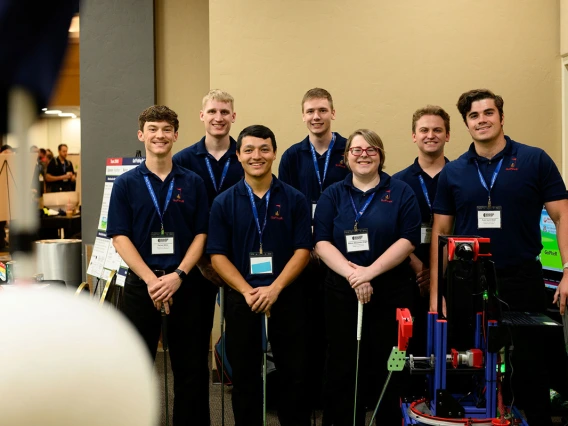
Interdisciplinary Capstone Team 25511’s compact lithography tool boosts workforce training in semiconductor manufacturing.
Over 500 students, faculty, industry partners and community members packed the University of Arizona mall at the College of Engineering's second Winter Craig M. Berge Design Day on Dec. 5.
Twelve Interdisciplinary Capstone teams, composed of 78 students from across majors, took advantage of the spring-start timing option for the Engineering 498 course.
The annual event is an opportunity for engineering seniors to present the results of their yearlong capstone class, a graduation requirement that prepares them for industry. Students had two semesters to design, prototype and test their projects to compete for $6,750 in prizes.
Inspiring interest in fast-growing tech field
Team 25511’s SEMILITHO won top prize – the Craig M. Berge Dean’s Award for Most Outstanding Project – and took home $2,500.
The photolithography prototype was a portable microscopic wafer patterning system designed for educational outreach events at the university.
Photolithography – a process that uses light to etch patterns on silicon wafers – is a key step in semiconductor manufacturing. The patterns shape intricate circuits on chips that power smart devices.
“Students can learn how micro-scale chip fabrication works without needing the large, expensive equipment normally required,” said Travis Reyna, an electrical and computer engineering student.
Materials science and engineering assistant professor Zafer Mutlu sponsored the project through his lab, the Advanced Nanoelectronics and Nanostructures Laboratory. He tasked the team with downsizing this crucial process to help build a pipeline into Arizona’s semiconductor workforce.
“A project like this is important because semiconductor processing has been a growing industry in the U.S., especially in the Phoenix area,” Reyna said. “We want to give high school students exposure to this industry and create outreach events to engage them.”
Housekeeping for solar panels
Another team’s project cleans hard-to-reach solar panels with SPUD, the Solar Panel Unmanned Decontaminator.
Team 25509 built an autonomous drone that detects dirt and cleans panels with pressurized water. Sponsor Vijayan Chomatil plans to establish a mobile cleaning service with the project.
“Learning to build a drone from the ground up was incredible and even better knowing it won’t just sit on a shelf,” said Bridger Sanborn, aerospace engineering student and project procurement lead.
The team coded the system to scan roofs using LiDAR, identify solar panels and automatically navigate the area.
“It sprays away dirt and debris to restore the panel’s efficiency without customers having to climb onto their roof,” Sanborn said.
Jaundice test improves newborn care
Medical device startup Pictuerus AS sponsored Team 25504 to create a low-cost jaundice testing device for newborns.

Team 25504's jaundice testing device is low-cost and reusable.
Jaundice is a serious condition caused by a buildup of bilirubin pigment in the blood, leading to a yellowish skin tint. In the most severe cases, untreated jaundice can cause brain damage. Current bilirubin testing methods require specialized equipment and trained personnel.
“We designed the device to be used in underserved regions where newborns often develop jaundice but lack access to reliable testing,” said Alyssa Pederson, a mechanical engineering student. “Traditional visual checks, like examining a baby’s chest, can be inaccurate across different skin tones.”
The team designed a plastic compartment to hold a blood-saturated test strip and the sponsor's calibration card – a guide that compares the strip's color to pigments associated with jaundice – so users can snap a photo on the sponsor's app. The app is a screening tool that provides clinically verified test results.
“By using a small blood sample instead of visual cues on the skin, our test provides consistent, reliable results for every patient,” Pederson said.
Access the winter Design Day photo gallery.
Winter Craig M. Berge Design Day 2025 Winners
Craig M. Berge Dean’s Award for Most Outstanding Project – $2,500
Team 25511: SEMILITHO: Semiconductor Lithography Tool Prototype
Abdullah Sahli, Maryah Almajnouni, Max Henderson, Travis Reyna, Nataly Islas and JD Rash
Project Sponsor: The Department of Materials Science and Engineering, Advanced Nanoelectronics and Nanostructures Laboratory (ANNLAB)
RBC Sargent Aerospace and Defense Voltaire Design Award – $1,500
Team 25502: Cat Cannon
Jose Elizarraras, Jenin Katbah, Axel Roman, Alireza Shariati, Daniel Northcott, Andrew Rivas and Skyler Stokes
Project Sponsor: BATYL Industries
Sharon ONeal Award for Best System Software Design – $1,000
Team 25503: Racing the Sun - Autonomously
Koby Butler, Emil Fischer, Connor Johnson, Kyle Letsinger, Eric Stewart, Alek Sepulveda and Jacob Mooney
Project Sponsor: Department of Systems and Industrial Engineering
Technical Documentation Consultants of Arizona Award for Best Design Documentation – $500
Team 25510: Dental Instruments Design to Reduce Hand Fatigue
Diego Delgado, Tanna McLeod, Warri Nagberi, Katie Thai, Tiffany Hudgins and Kayla Griffith
Sponsor: Tucson Biological Dentistry
Larry Head Award for Best Video Capturing the Project Story – $500
Team 25508: 3D Printer Plastic Filament Shredder
Jake Ciasca, George Davis, Thomas Lersch, Allyson Texley, Christian Monreal, Nicholas Petrov and Zackary Tileston
Sponsor: Engineering Design Center
Doug May Award for Excellence in Stochastic Methods for Engineering Design – $500
Team 25507: 3D Printing and Topological Optimization - The Holy Grail of Additive Manufacturing
Ashlyn Adakai, Ali Ibrahim Alqahtani, Khaled Alqahtani, Ciaran Burckel, Lance Oldham, Jarrod Land and Ryan Mccabe
Sponsor: Cummings Aerospace
AZ Technica Award for Best Use and Implementation of Engineering Standards – $500
Team 25510: Dental Instruments Design to Reduce Hand Fatigue
Diego Delgado, Tanna McLeod, Warri Nagberi, Katie Thai, Tiffany Hudgins and Kayla Griffith
Sponsor: Tucson Biological Dentistry