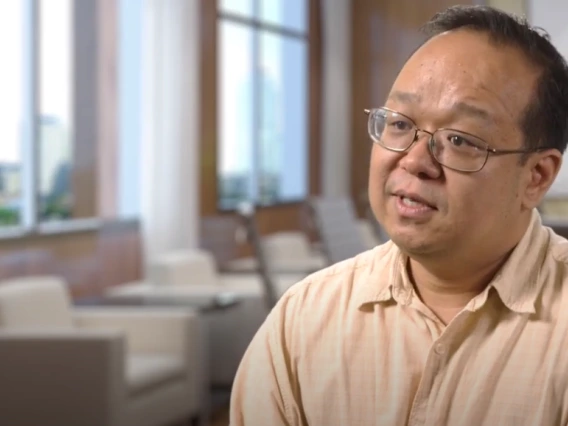
IEEE honors Hao Xin with prestigious John Kraus Antenna Award
The College of Engineering professor is renowned for original antenna designs that lower costs and boost performance.

School of Electrical, Computing, and Software Engineering professor Hao Xin earns the John Kraus Antenna Award for pioneering 3D-printed antennas and wireless sensing.
Hao Xin, professor in the School of Electrical, Computing, and Software Engineering, has earned one of the field's highest honors from the Institute of Electrical and Electronics Engineers: the John Kraus Antenna Award.
“This award is deeply meaningful because it celebrates work that I have pursued for many years out of genuine curiosity and a desire to contribute something lasting to the field,” said Xin, Thomas R. Brown Endowed Fellow.
The IEEE and IEEE Antennas and Propagation Society annually honor individuals who improve technology or have made meaningful contributions to society. The John Kraus Antenna Award is a lifetime achievement award that recognizes a career advancing antenna engineering.
Xin has spent 20 years developing 3D-printed antennas and wireless sensing devices that transformed how complex electromagnetic devices are designed and manufactured.
“This is also the result of the hard work of many students, colleagues and postdoctoral researchers,” he said. “It represents years of research and collaboration.”
Upending antenna manufacturing
When Xin began exploring 3D printing in 2007, manufacturing advanced antennas such as Luneburg lenses – specialized structures that focus and direct radio waves for radar and satellite communications – was costly and often impractical, particularly for high-frequency systems used in advanced radar and wireless communications.
He applied 3D-printing technology to overcome cost barriers and make the devices more accessible.
Xin and his team produced their first high-frequency 3D-printed Luneburg lens in 2009, then spent the next five years refining the process to scale manufacturing.

(From left) Gianluca Lazzi, IEEE Antennas and Propagation Society Awards Committee Chair; Hao Xin, professor in the School of Electrical, Computer, and Software Engineering; and C.J. Reddy, IEEE Antennas and Propagation Society president, at the 2026 IEEE International Symposium on Antennas and Propagation in Detroit, Michigan on July 12.
“Using conventional methods, you simply couldn't make these lenses,” Xin said. “With 3D printing, not only could we build them, but we could manufacture them at a reasonable cost.”
After publishing some of the earliest studies on 3D-printed electromagnetic devices, he became a resource for companies and researchers seeking fresh ideas for antenna applications.
“Not only did we develop new technology, but we also inspired a larger community to explore this area,” said Xin, who leads the Millimeter Wave Circuits and Antennas Laboratory.
His lab develops advanced antenna systems and electronic devices that operate across a wide range of frequencies, supporting technologies such as wireless communication and radar. Xin’s goal is to manipulate materials that shrink the devices while maintaining efficiency.
He is also developing radar and wireless sensing technology for vehicles to detect and track small objects, a boon to safe driving. This technology can monitor the increasingly crowded radio-frequency spectrum used by connected vehicles, helping researchers better understand how wireless signals interact on the road.
“Our focus is on creating new antenna designs and technologies that weren't possible before,” he said. “At the same time, we want to make sure they have real, practical applications that improve people's daily lives.”
Mentoring leaders in tech
For Xin, some of his proudest accomplishments are not only the technologies developed in the lab, but the students who helped bring those ideas to life. He sees mentorship as one of the most rewarding parts of the job.
“When I see students come in for the first time, maybe not knowing how to pick up a soldering iron or connect a cable and then watch them become research experts a few years later, that’s one of the most valuable experiences,” Xin said.
Several of his students went on to careers at Apple, Broadcom and Qualcomm.
“We want to keep improving these technologies so they can move beyond the lab and become part of people’s daily lives and industry,” Xin said.