Big Idea Challenge powers orbital data center development
Materials science engineer Krishna Muralidharan leads an interdisciplinary U of A team that won $250,000 to overcome technical challenges in off-Earth data centers.

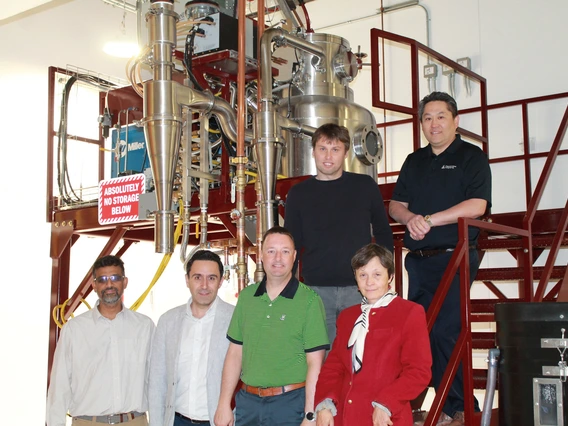
Krishna Muralidharan, professor of materials science and engineering, applies expertise in extreme space materials to move data centers into Earth’s atmosphere.
Kris Hanning, U of A Office of Research and Partnerships
A University of Arizona research team is working to launch data centers into Earth’s orbit. The project, AZSCI, pronounced "A-Z Sky,” aims to meet the ever-growing demand for data storage while reducing environmental impacts and improving security and performance.
AZSCI was among six projects to receive $250,000 as part of the Office of Research and Partnerships' inaugural Big Idea Challenge, a program that fuels solutions to some of society's most pressing issues.
"The university has an opportunity to stay ahead of the curve, become the domain leader and radically rethink what is possible," said Krishna Muralidharan, principal investigator for AZSCI and director of the U of A Center for Semiconductor Manufacturing.
AZSCI taps U of A experts to join the burgeoning space computing industry, said co-principal investigator Karthik Kannan, the Halle Chair of Leadership and dean of the Eller College of Management.
"There is huge potential for companies. The U of A can bundle our strengths, and they can benefit from making investments," Kannan said. "The next wave of innovation and exploration is in space. This becomes the steppingstone."
Early commercial efforts highlight growing interest in space-based computing capabilities. U.S. startup Starcloud recently launched a satellite demonstrating early in-orbit computing capabilities, while Google's Suncatcher project plans to launch test satellites by 2027 for machine learning workloads. Additionally, Axiom Space is developing orbital infrastructure with embedded computing capabilities.
"Space-based data centers represent a profound shift in how the world will store, process, move and secure information, and the University of Arizona intends to help shape that future," said Tomás Díaz de la Rubia, senior vice president for research and partnerships. "By uniting our strengths across advanced semiconductor manufacturing, optical and space sciences, and policy, we are positioning the university – and our partners – to lead a transformative technological frontier."
Meeting regional needs with sustainable solutions
Traditional data centers consume vast amounts of electricity to power thousands of high-performance computers. These systems support artificial intelligence tools and massive datasets. The U.S. Energy Information Administration estimates that computing accounted for around 8% of commercial sector electricity consumption in 2024 and could grow to 20% by 2050.
The centers also require large amounts of water for cooling. A 2025 Congressional Research Service report shows a large U.S. data center may consume roughly the same amount of water as 2,600 households.
An orbital data center – a constellation of satellites in orbit outside Earth's atmosphere – offers solutions to those challenges. Operating in space eliminates the need for land, leverages abundant solar power and naturally cool conditions for better energy efficiency.
"As Southern Arizona expands its technology sector, we need forward-thinking solutions that not only drive economic growth but also strengthen our digital infrastructure without overtaxing our natural resources," said Tucson City Council member Nikki Lee, adding, “the U of A's research… is crucial for securing our data future and attracting the next wave of high-tech investment to our region.”
Collaboration speeds prototypes
AZSCI’s initial objective is to design data center hardware and systems, including servers, storage, power, cooling equipment and communications technology.
Muralidharan, also a professor of materials science and engineering, is focused on developing materials and devices that can function in extreme space environments.
"Without materials, none of this happens," he said. "We will tackle material challenges in stages."
The first step will be modifying existing technologies, testing how they perform in space and gradually adapting them for harsher conditions. Later phases would introduce new materials and hardware, improving space computing security by reducing cyber vulnerabilities and enabling rapid decision-making in orbit.
In 2027, the team will finalize a digital twin of an orbital data center. This virtual model will test software, communications systems and simulate responses to cyberattacks.
The digital twin will be presented to potential industry and government partners for input, bolstering the research team’s customization of physical prototypes to meet specific needs, such as national defense.
As the team prepares for these coming phases, Muralidharan said the Big Idea Challenge seed funding equips the project to move forward.
"It allows us to nucleate around a good idea and bring all the stakeholders into place," he said. "We can grow this into something that's feasible and tangible. It's not pie in the sky."